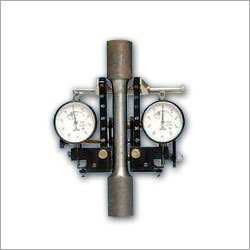
About Mechanical Extensometer
Since the year 1983, our enterprise is engaged in manufacturing, exporting and supplying supreme quality
Mechanical Extensometer. The provided extensometer is manufactured using optimum quality components with the aid of progressive techniques under the strict vigilance of our adroit professionals. This extensometer is widely used by the clients for measuring the elongation of test specimen like metal and alloy under several loads. Moreover, the offered
Mechanical Extensometer can be easily purchased from us cost effective rates.

Features:- High performance
- Durable
- Easy to use
- Rugged design
Precision Measurement with Durable ConstructionDesigned from high-grade stainless steel and aluminum, the extensometer ensures both longevity and measurement accuracy. Its nickel-plated, corrosion-resistant finish safeguards the instrument in lab environments, while hardened knife-edge contacts enhance precision and reliability over years of operation.
User-Friendly Manual Operation and VersatilityThis device features fully manual clamp-on mounting and vernier scale reading, allowing quick, easy attachment to specimens of varying shapes and sizes. Suitable for flat or round specimens, its adjustable gauge lengths and robust build meet testing requirements of diverse industries.
Compliant and Maintenance-Free Mechanical SolutionWith strict adherence to IS:12872 and ASTM E83, this extensometer offers trusted compliance for professional laboratories. Its mechanical (power-free) operation enables use in varied settings, offering a service life exceeding a decade with routine caremaking it a cost-effective solution.
FAQs of Mechanical Extensometer:
Q: How do I mount the mechanical extensometer onto a specimen for testing?
A: The extensometer is manually clamped onto the test specimen using its dedicated clamp arrangement. Simply adjust the gauge length as needed, position the hardened steel knife-edges on the specimen, and secure the device before beginning the tensile test.
Q: What types of specimens and machines is this extensometer suitable for?
A: It is compatible with both flat and round specimens conforming to IS:12872 standards, and can be used with Universal Testing Machines (UTM) in laboratory environments.
Q: When should the gauge length be adjusted on the extensometer?
A: Gauge length adjustment is necessary based on your test requirements. You can select between 25 mm, 30 mm, or 50 mm gauge lengths prior to mounting, using the built-in adjustment mechanism.
Q: Where can this extensometer be effectively used?
A: This extensometer is ideal for material testing laboratories, quality control departments, research facilities, and educational institutions that conduct tensile testing of metals and alloys.
Q: What is the measurement process and how accurate are the readings?
A: The extensometer measures displacement mechanically via a vernier scale, providing instantaneous readings with an accuracy and resolution of 0.01 mm. The operator records the measurements manually during tensile testing.
Q: How does the corrosion-resistant finish benefit the equipment?
A: The nickel-plated corrosion-resistant finish protects the extensometer against oxidation and environmental factors commonly encountered in laboratory conditions, ensuring enhanced longevity and consistent performance.
Q: What are the key benefits of using this mechanical extensometer?
A: Key advantages include its robust and lightweight design, high precision, maintenance-free mechanical operation, portability, wide adaptability, and compliance with international standards, making it a cost-effective and reliable choice for extensometry.